Coffee Grind Size Chart for Every Brew Method (2026)
Grind size is the setting that changes your coffee the most. This chart lists the grind each popular brew method needs, what it should look and feel like, and the typical particle size, compiled from published expert guides.
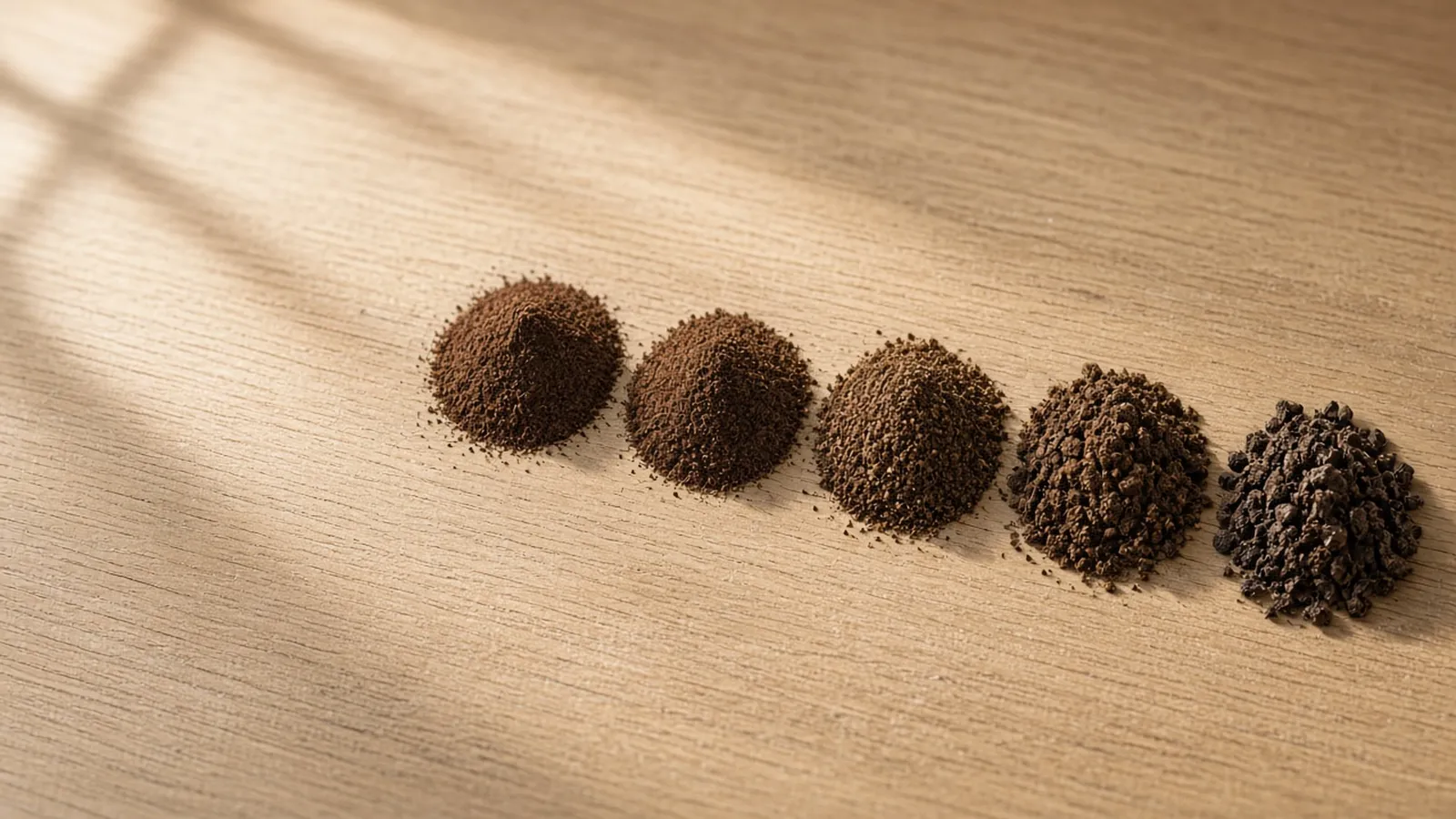
Quick answer: go finer as contact time gets shorter. Turkish coffee is powder-fine, espresso a little finer than table salt, pour-over medium-fine, drip medium (like sand), French press coarse (like sea salt) and cold brew extra coarse (like ground peppercorns).
- Sour cup? Grind finer.
- Bitter cup? Grind coarser.
- Different grinder? Numbers don’t transfer; use texture and taste.
Coffee grind size chart
Methods run from finest to coarsest. Micron (µm) ranges come from Honest Coffee Guide, which bases them on original brewer guides and popular recipes. Grind names and texture comparisons come mostly from Home Grounds. Treat every range as a starting zone: every grinder makes a spread of particle sizes, and the same setting differs between grinders.
| Brew method | Grind size | Looks/feels like | Typical range | Dialing-in tip |
|---|---|---|---|---|
| Turkish (cezve/ibrik) | Extra fine | Like flour or powder | 40–220 µm | The grounds stay in the cup, so there is no filter to clog. Most home burr grinders can’t go this fine; Home Grounds says you need a grinder made for Turkish coffee. |
| Espresso | Fine | A little finer than table salt | 180–380 µm | Espresso is the least forgiving. Too fine and water barely gets through; too coarse and it gushes. Change the grind in very small steps. |
| Moka pot | Fine to medium-fine | Gritty between your fingers, but not powdery (Bialetti’s description) | 360–660 µm | Go slightly coarser than espresso. Honest Coffee Guide warns that an espresso grind can block a moka pot. |
| AeroPress | Fine to coarse, depends on steep time | Table salt (short brews) to sand (3+ min brews) | 320–960 µm | Match grind to time: fine for about 1 minute, medium-fine for 2–3 minutes, medium for 3+ minutes. Start at medium and adjust. |
| Pour-over cone (V60, Kalita) | Medium-fine | Finer than sand, coarser than espresso | V60: 400–700 µm (pour-over overall: 410–930 µm) | Start medium-fine. If the cup is sour, go finer or brew a little longer; if bitter, go coarser. |
| Chemex | Medium-coarse | Coarse sand to sea salt | Within the 410–930 µm pour-over range, toward the coarse end | Chemex’s thick filter drains slowly, so grind coarser than a V60. Rinse the paper filter before brewing. |
| Drip coffee machine | Medium (medium-fine for cone baskets) | Regular sand | 300–900 µm | The right setting varies a lot by machine. Flat-bottom baskets usually want medium; cone-shaped baskets a touch finer. |
| Siphon (vacuum pot) | Medium to medium-fine | Regular sand | 375–800 µm | Too fine slows the drawdown and lets fines into the lower chamber. If it stalls, go coarser. |
| French press | Coarse | Like sea salt | 690–1,300 µm | Plunging is your test: hard to push means too fine; it drops with no resistance means too coarse. |
| Cold brew | Extra coarse | Like ground peppercorns | 800–1,400 µm (some recipes go coarser) | The longer the steep, the coarser the grind. Home Grounds says never go finer than medium. |
How to read the chart
The basic rule: the shorter the water touches the coffee, the finer you grind. Espresso extracts in under a minute under pressure, so it needs a fine grind and lots of surface area. Cold brew steeps for many hours, so it needs very coarse grounds to keep from turning harsh. Pour-over, drip and siphon sit in the middle.
Honest Coffee Guide groups grind sizes into 200-micron steps: extra-fine (0–200 µm), fine (200–400), medium-fine (400–600), medium (600–800), medium-coarse (800–1,000), coarse (1,000–1,200) and extra-coarse (1,200–1,400). Other guides use the words differently. One person’s “medium” is another’s “medium-fine,” which is why the texture column is useful.
You won’t measure microns at home. Lab-grade measurement needs tools like a laser diffraction analyser. Instead, rub a pinch of grounds between your fingers, compare with the texture column, brew, and adjust by taste.
Troubleshooting: dial in by taste
Whatever the method, the cup tells you which way to move. Home Grounds’ rule of thumb:
| If your coffee tastes… | It’s probably… | Grind | Also try |
|---|---|---|---|
| Sour, sharp, salty or thin | Under-extracted | Finer | Longer brew time or hotter water |
| Bitter, harsh, dry or hollow | Over-extracted | Coarser | Shorter brew time or slightly cooler water |
- Change one variable at a time. Keep dose, water and time the same, move the grind one step, and taste again.
- Weigh your coffee. If the dose changes every morning, you can’t tell whether the grind fixed anything. A coffee scale with a timer lets you track dose and brew time together.
- Watch the physical signs. A French press that is hard to plunge, an espresso shot that barely drips, a slow pour-over drawdown or a siphon that stalls all point to a grind that is too fine.
- Sour and bitter at once? That usually means an uneven grind: fines over-extract while boulders under-extract. Home Grounds’ fix is a burr grinder instead of a blade grinder.
Why the grinder matters as much as the setting
A chart only helps if your grinder can hit the target consistently. Blade grinders chop beans into a mix of dust and chunks, so no single setting is right. Honest Coffee Guide leaves them out of its chart for that reason. Burr grinders crush beans between two burrs to a set gap, which gives a much tighter spread.
Range matters too. Filter-focused hand grinders handle pour-over through French press well but often lack the fine steps espresso needs; see my burr grinders for pour-over under $100. If you pull shots, look at my espresso grinders under $200, and pair one with one of my espresso machines for beginners. Brewing on the stove? See my best moka pots for stovetop picks that suit a medium-fine grind.
Gear for each grind
- Best burr grinders for pour-over under $100
- Best espresso grinders under $200
- Best espresso machines for beginners
- Best pour-over coffee drippers
- Best French presses
- Best cold brew coffee makers
- Best coffee scales with timer
Frequently asked questions
What grind size should I use for drip coffee?
A medium grind, about the texture of regular sand, suits most flat-bottom drip machines; cone-basket machines often do better slightly finer. Honest Coffee Guide puts drip machines at roughly 300–900 microns because the right setting varies so much between models, so start in the middle and adjust by taste.
Why does my coffee taste sour or bitter?
Sour, sharp or salty usually means under-extraction: grind finer (or brew a little longer or hotter). Bitter or hollow usually means over-extraction: grind coarser (or shorten the brew). Change one thing at a time.
Is a finer grind stronger?
Not automatically. Home Grounds notes that finer coffee extracts faster and can taste more bitter, which people mistake for strength. To make coffee stronger, use more coffee per cup of water rather than grinding finer.
Do grinder numbers mean the same thing on every grinder?
No. Settings aren’t universal. A “2” on one grinder isn’t a “2” on another, and even two units of the same model can differ. Use the textures and micron ranges here as a starting point, then dial in by taste.
Can I use a blade grinder?
You can, but it grinds unevenly: a mix of dust and chunks that brew at different speeds. Both sources I used recommend a burr grinder, and Honest Coffee Guide leaves blade grinders out of its chart because they can’t grind consistently.
Share or embed this chart
Bloggers, baristas and teachers are welcome to quote this chart or reproduce the table, as long as you credit me with a link back to this page. Suggested credit:
<a href="https://bestbyniche.com/coffee/coffee-grind-size-chart/">Coffee grind size chart</a> via BestByNicheIf you reuse the micron ranges, please credit Honest Coffee Guide too.